By Roshan D’Souza, Mortgage Agent Level 2, Mortgage Architects
A smart mortgage payoff strategy for landlords starts with recognizing that not all mortgage debt is equal. If you own a home and a rental property, you have two mortgages that look almost identical on paper: same lender, maybe even the same rate. But financially, they are not the same debt, and treating them the same costs landlords real money every year.
Key Takeaways
- Interest on your primary home is not tax deductible in Canada. Interest on a rental mortgage often is, because it is borrowed to earn income.
- At a 45 percent tax bracket, a rental mortgage at 4.5 percent has a real cost closer to 2.5 percent after the deduction.
- Extra cash pays down your non-deductible primary mortgage more efficiently than your rental mortgage, dollar for dollar.
- Offset mortgages (like Manulife One) and cash damming are two ways to structurally speed this up, not just prioritize which cheque to write.
Why Your Mortgage Isn’t All One Debt
In Canada, mortgage interest on your principal residence is not tax deductible. It is a personal expense, full stop. But interest on money borrowed to earn income, including a rental property mortgage, generally is deductible under CRA rules.
That single distinction changes how you should treat two mortgages that otherwise look the same.
The Math at Today’s Rates
Say you carry a $500,000 mortgage on your primary home and a $400,000 mortgage on a rental, both at 4.5 percent.
Your primary home costs you $22,500 a year in interest and gives you nothing back at tax time.
Your rental costs you $18,000 a year in interest. But because that interest is a write-off against rental income, and most landlords we work with land around a 45 percent marginal tax bracket once rental income stacks on top of employment income, that deduction is worth $8,100 a year. Your real cost on the rental debt drops to $9,900, an effective rate closer to 2.5 percent.
Same rate, same lender, two very different real costs.
The $50,000 Question
Now say you have $50,000 in savings and you’re deciding where to put it.
Apply it to the primary mortgage, and you save $2,250 a year in interest. Clean, no tax angle either way.
Apply it to the rental mortgage instead, and you save $2,250 in interest too, but you also lose $1,013 of the tax deduction that interest was generating. Your net saving drops to $1,237.
Same $50,000, same rate, and the primary mortgage wins by just over $1,000 a year, every year, for as long as both mortgages are outstanding.
Bottom line: pay down the debt that costs you. Keep the debt that works for you.
Two Ways to Speed This Up
Knowing which mortgage to prioritize is step one. These two strategies help you get there faster without changing how much you earn or spend.
Offset Mortgages (Manulife One)
An offset mortgage holds your income, savings, and mortgage balance in the same account, and interest is charged only on the net balance.
Keep $10,000 sitting in the account, and you’re only charged interest on $490,000 of a $500,000 balance, every single day. Payday hits, your balance drops, your interest drops with it. No change to your spending habits required.
Manulife One is the closest product to a true offset mortgage available in Canada.
Read our full breakdown of the Offset Mortgage strategy →
Cash Damming
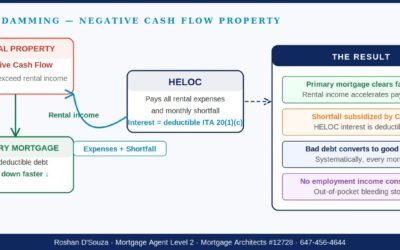
Cash damming is built specifically for landlords who also carry a personal mortgage. Instead of using rental income to pay rental expenses, you redirect it to your primary mortgage. You then re-borrow that same amount through a re-advanceable HELOC to cover the rental expenses instead.
Because that re-borrowed money is now used for the rental, the interest on it becomes tax-deductible. Your total debt does not grow. It converts from the kind that costs you to the kind that works for you, and any tax refund can go straight back to the mortgage to accelerate the cycle further.
Read our full breakdown of Rental Cash Damming →
Is This Right for You?
This applies to you if:
- You own your primary residence and at least one rental property
- You have a mortgage on both
- You have (or could access) extra cash or a re-advanceable line of credit
- You want to reduce interest costs without increasing risk or changing your income
It’s worth five minutes before you decide where extra cash goes, and it’s worth a conversation before you restructure anything.
FAQ
Is mortgage interest on my primary home ever tax deductible in Canada? Generally no. Interest on a mortgage for your principal residence is a personal expense and is not deductible. The exception is when borrowed funds are used for an income-producing purpose, which is the basis of strategies like cash damming and the Smith Manoeuvre.
Should I always pay off my rental mortgage last? In most cases, yes, if your goal is maximum after-tax efficiency and the rental interest is deductible. But every situation is different depending on your tax bracket, cash flow needs, and long-term plans for the property.
What tax bracket do most landlords fall into? It varies, but many landlords who also earn employment income land in the 40 to 50 percent marginal bracket once rental income is added on top. That is why the deduction on rental mortgage interest carries real weight.
Is cash damming legal in Canada? Yes. CRA’s Income Tax Folio S3-F6-C1 sets the rule: interest is deductible when borrowed money is used to earn income from a business or property. Cash damming is structured to meet that test, as long as you keep clean documentation and never mix personal and rental funds in the same account. Professional guidance is recommended before you implement it.
The Bottom Line
Your primary mortgage and your rental mortgage might look identical on your statements. They are not identical on your tax return. Knowing the difference, and structuring your cash accordingly, is worth thousands of dollars over the life of both mortgages.
Want to know what this looks like with your actual numbers? Book a quick call and we’ll map it out together.
Disclaimer: This article is provided for general educational purposes only and does not constitute financial, legal, or tax advice. Readers should consult qualified professionals before making decisions based on this content.