
Offset Mortgage Canada: How Manulife One Can Cut Years and Thousands of Dollars in Interest Off Your Mortgage
If you’re carrying a traditional mortgage in Canada, you’re likely paying more interest than you need to, simply because of how the payment structure works. An offset mortgage changes that. It links your income and savings directly to your mortgage balance, so every dollar sitting in your account reduces the interest you’re charged, every single day.
In Canada, Manulife One is the main product that does this properly. It’s not a HELOC bolted onto a mortgage. It’s one account that combines your mortgage, chequing, and savings, and recalculates your interest daily based on what’s actually sitting in there.
The Traditional Mortgage vs. The Offset Mortgage
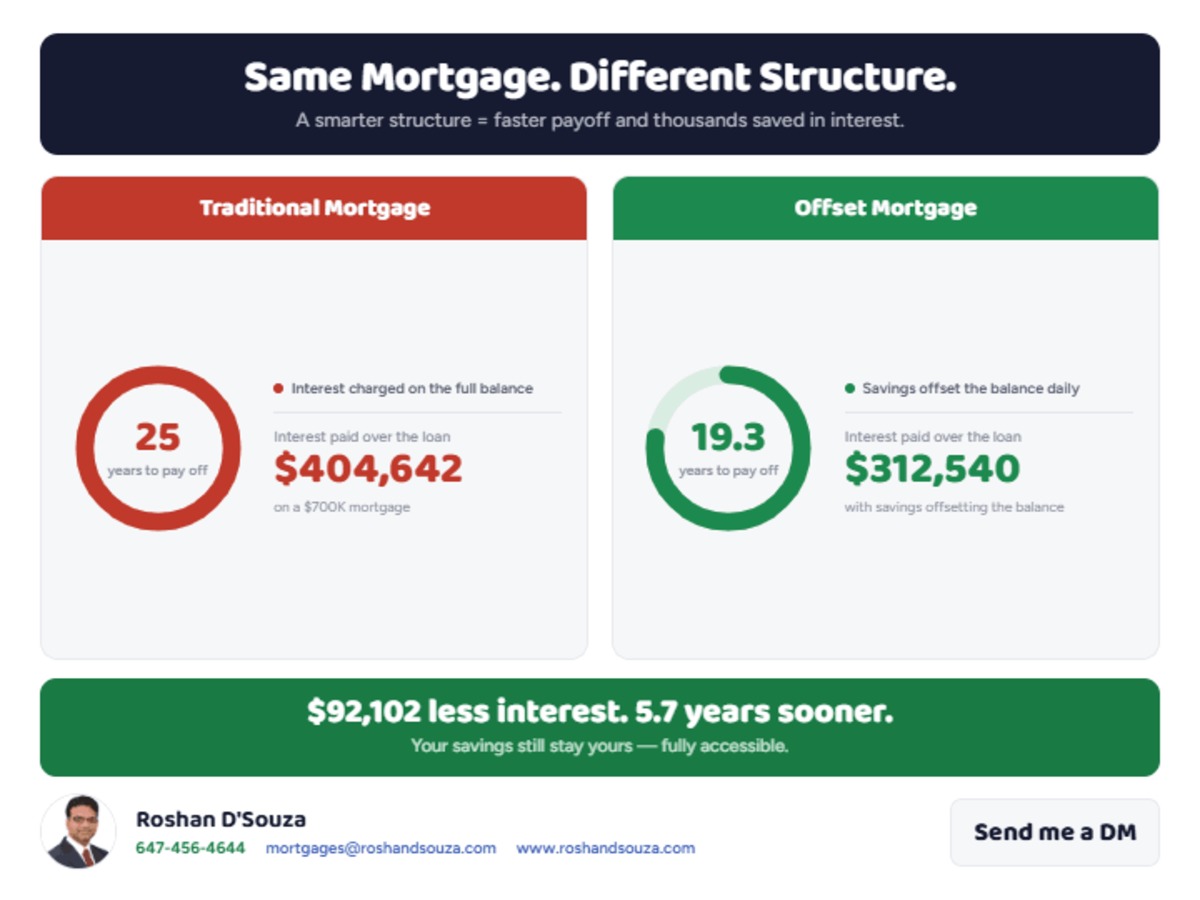
Picture two people with the same $700K mortgage, same rate, same income. One sticks with a traditional mortgage. The other uses an offset structure with Manulife One.
Traditional mortgage: 25 years to pay off, $404,642 in total interest paid.
Offset mortgage (Manulife One): 19.3 years to pay off, $312,540 in total interest paid.
That’s 5.7 years off the mortgage and $92,102 less paid in interest, without increasing the payment and without changing the person’s income or spending habits. The only thing that changed is where their money sits while it’s waiting to be spent.
With a traditional mortgage, your payment is fixed and your amortization schedule doesn’t care how much cash you’re holding in a chequing account earning nothing. With Manulife One, every deposit, your paycheque, rental income, savings, immediately offsets your mortgage balance. Interest is calculated daily on the net amount. You still have full access to your money. You’re just not letting it sit idle while your mortgage balance keeps accruing interest against the full amount.
Who This Makes Sense For
An offset mortgage isn’t for everyone. It tends to work best if:
- Your income consistently exceeds your spending, so you’re carrying a cash buffer
- You want flexibility to access equity without refinancing every time
- You’re a landlord or self-employed and want a structure that also supports cash damming or tax-efficient debt strategies
- You have at least 20 percent equity or down payment, ideally more
If you spend every dollar you earn as it comes in, a traditional mortgage may genuinely serve you better. Part of my job is figuring out honestly which camp you’re in before recommending anything.
Manulife One is often shortened to M1, and if you’re comparing offset mortgage Canada options, Manulife One is usually the specific offset product being referenced. Unlike a standard readvanceable mortgage, Manulife One combines your mortgage, income, and everyday spending into one offset account with a single credit limit, so there’s no separate HELOC to track or renew. For most homeowners weighing an offset mortgage Canada strategy, the real appeal of Manulife One isn’t just the interest savings shown above, it’s the simplicity of managing one offset balance instead of juggling a mortgage and a line of credit separately.
See the Numbers on Your Own Mortgage
The example above is based on a $700K mortgage, but every mortgage is different. I run a full comparison using your actual balance, rate, and cash flow so you can see the real interest saved and years cut off your specific situation. That’s part of the conversation when we talk.
Offset Mortgages for GTA Landlords and Self-Employed Borrowers
If you own rental property or run an incorporated business, an offset structure can also be paired with cash damming, converting non-deductible mortgage interest into tax-deductible investment debt. This is where the strategy gets more advanced, and where working with someone who understands both the mortgage mechanics and the CRA rules around it matters most.
Let’s Look at Your Numbers
If you want to see whether an offset mortgage makes sense for your specific situation, book a call and we’ll walk through it together.